
HF processing (High-Frequency processing)

Automation and monitoring in electric power industry

Spare parts for high-voltage equipments

Instruments and devices
.png&w=96&q=75)
Equipment for SF6 (Sulfur Hexafluoride)

Railway equipment

Telecommunication equipment
Technological equipment
Original product with a 15% discount



- Main
- HF processing (High-Frequency processing)
- The High-frequency line trap
аrt.53
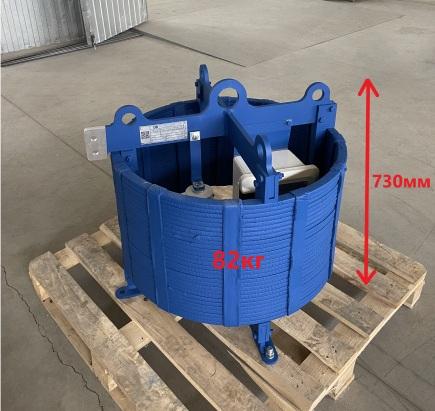
The High-frequency line trap
The main purpose of the High-frequency line trap is to reduce the effect of the shunting action of the substation buses on the linear path of the high-frequency channel, when processing overhead power transmission lines (OPL) for the purpose of transmitting emergency control signals, relay protection, digital data, telemetry and telephone communications on carrier frequencies from 16 kHz to 1000 kHz via their phase wires and lightning protection cables, as well as to eliminate the shunting action of the branches (splitters) of the OPL.
- Description

- Technical specifications
- Documents (certificates)
The High-frequency line trap (HFLT) is designed for continuous operation outdoors at ambient temperatures from minus 50 C to plus 50 C under the influence of solar radiation, rain, snow, ice and dust, at an altitude of up to 2000 m above sea level. The climatic version of the HFLT is UHL1 according to GOST 15150 for operation outdoors in an atmosphere of type II (industrial). The VCHZ is designed to operate at a network frequency of 50 Hz and an oscillation shape that can be considered sinusoidal.
The following main functional elements are included in the high-frequency suppression device:
- Reactor KMTL.672161.003
- Primary protective device. An overvoltage limiter is used as the primary protective device. The suppressors comply with the requirements of technical specifications TU 3414-002-15207362-2003.
- Tuning element. KMTL.468829.002 - ENS (broadband) and KMTL.468829.003 - ENP (bandpass) determine the rejection frequency range of the high-frequency suppression device. Each reactor type has its own tuning element. The type of EN is determined solely by the reactor's inductance and is independent of its rated current. Example entry for a separate EN order:
ENSh – XX (reactor inductance) – XX (blocking range)
The following climatic versions of the VChZ are available: U1, HL1, and UHL1, according to GOST 15150.
По запросу